This form will also take more of a inception into the interior, and provide a book shaft through the centre of the entire building latching itself the both the ground(for stair access) and roof for support.
2.5.10
parasitic access.
a decision i made whilst modeling the conceptual presentation was to further the parasitic access design, and redesign if away from the timber controlled design it took in modeling and towards a more coral-like form, a growth//. for example the tubular shape could take on a form similar to this.
https://blogger.googleusercontent.com/img/b/R29vZ2xl/AVvXsEicljb5qJV_qqBtUn-jg9UoQ6ZcQcrT1I_QkZiSZ-aFytsKKT0bGasdrWK5KqIHWTK8blIFcyoJIFLdCU8R6tRUp1VxE7Ji2buuH_P-Rf90fZ5mFXZtwSesrME_D6GTZKPqykuj64ODc4s/s1600-h/bone_flat.JPG
conceptual presentation of a flexible design.
so last week our conceptual presentation was due, and i figured this presentation to be a fairly flexible design that may be adaptable to our site. these slides were the product for this presentation.
just a little loose layout planning. showing the raised floor for a floor to ceiling book shelf. this layout planning will undergo major alterations.
the roof design forms the most prevalent part of the concept, and is a combination of a structural cage and sails that reminisce from the original folie design, the sails are loose and provide acknowledgment of the outside conditions.

Plans for further exploration of the concept have been made and will be explained in further blog posts.1.5.10
casemoth cocoon.
This was intended to be an earlier post as it formed a study into the form that was pursued for the initial concept, and that was the form of a case moth's cocoon.
http://farm1.static.flickr.com/51/144293133_74ffbc925b.jpg
Seen above the case moth's cocoon interested me for a few reasons, those being:
1. It's near relation to parasites, attaching itself to whatever it sees fit.
2. In my opinion one of the clearest examples of evolution, one thing goes into the cocoon state, the case worm, and a completely different thing comes out, the case moth. I believed this analogy related rather well to a library.
3. The generally intriguing nature of its form.
http://farm1.static.flickr.com/51/144293133_74ffbc925b.jpgSeen above the case moth's cocoon interested me for a few reasons, those being:
1. It's near relation to parasites, attaching itself to whatever it sees fit.
2. In my opinion one of the clearest examples of evolution, one thing goes into the cocoon state, the case worm, and a completely different thing comes out, the case moth. I believed this analogy related rather well to a library.
3. The generally intriguing nature of its form.
All these things are hopefully correlated into the concept design.
17.4.10
Sails and the Structure.
Pushing my model further, for the deadline of a concept presentation.. i considered an exterior cladding system and decided to utilize a similar system that was used in my folie design. These sails are to be replicated through the interior also, to create intriguing spaces for reading. Going about the model exterior, i decided to mass create simple sails. here is the results:
Before they were glued on, just checking how they would look.
Gluing Process begins, an overlapping of sails gave a nice gaped effect.

Slowly covering the framework on both sides.
Completely covered framework, has a cocoon like look. The Sails have movement, to show the effect of winds upon the building.
Front end of library, the large slit in the side is for entrance gangplank with style i am yet to determine.
The right hand side of the building, the sails will act as a light diffusing system, to create good light to both protect the books and read.
Still yet to determine what protects the building from the elements other than these sails.
Exterior of building at night times, not as bright but the idea is there.
Interior with sun shining through in the day.. once again idea is there.
Before they were glued on, just checking how they would look.
Gluing Process begins, an overlapping of sails gave a nice gaped effect.
Slowly covering the framework on both sides.
Completely covered framework, has a cocoon like look. The Sails have movement, to show the effect of winds upon the building.
Front end of library, the large slit in the side is for entrance gangplank with style i am yet to determine.
The right hand side of the building, the sails will act as a light diffusing system, to create good light to both protect the books and read.
Still yet to determine what protects the building from the elements other than these sails.
Exterior of building at night times, not as bright but the idea is there.
Interior with sun shining through in the day.. once again idea is there.From here the design needs an interior layout and design which i plan to model within the next few days.
Caging the books: part II.
Attempting a modeling solution in a rigid frame style did not give the intended result, however it provided a good learning curve, and i continued to put that learning curve to practice in a curved cage design. The results were good however the media limited the model too a small size with large beams which were undesirable but would have to do at this stage.
The result. (notice cage beams depths)
The interior walls aesthetic from the cage.
And another more clear picture of beam size, horizontal beams along side for spacing and support.
The result. (notice cage beams depths)
The interior walls aesthetic from the cage.
And another more clear picture of beam size, horizontal beams along side for spacing and support.This was a great exercise which i plan to take further soon, and hopefully the result is something that somewhat resembles my earlier concept.
14.4.10
Rhino Experimentation.
I attempted to run my concept through rhinoceros 3-D without grasshopper (because of working on a apple mac computer), this proved helpful but did not replicate results that i was happy with. The following is some of the outcomes that i achieved.
The exterior cage and side entrance to the library.
Inside looking at the pillar-cutout and the inside of the side door.
The exterior cage and side entrance to the library.
Inside looking at the pillar-cutout and the inside of the side door.
11.4.10
modeling the cage.
After drawing up some rough concept ideas for the library some refinement of the form had to be done, and i figured doing this through modeling both digital and physically would be the best way to refine them, this is my physical modeling efforts.
Looking at the form it is a little too rigid and formal compared to my concept, moving from this i would like to design a more organic and cocoon like form, which attaches itself too the site like a parasite being our class objective.2.4.10
Progressing the Design
The design after considering these early things began to progress into a rough concept, with the details and ideas to be refined over time.
This first image is the progression from a simple form into a more detailed view of the outer skin. the drawing does not demonstrate the form incredibly well, so i am hoping that it becomes more clear when computer modeled.
This first image is the progression from a simple form into a more detailed view of the outer skin. the drawing does not demonstrate the form incredibly well, so i am hoping that it becomes more clear when computer modeled.on an unrelated note.. INVASION.
unrelated to this project. this is a piece i recently completed this drawing for a remembering card for a birthday. I'm particularly proud of it, has fun written all over it and took me about 30 minutes to draw.
The inspiration for which came from the birthday girls interest in robots, and a little bit of my interest in robot artwork, personally my favourite is the small round unit second from the front.
Sails of The past.
Looking back over my folie, i was having a look at the sails and decided to have a quick look around the internet for some examples of sails in architecture.
This is an installation in the 3G extension gallery, i particular like the space it creates and it could be somewhat applied in my own design. I feel these forms are particularly interesting and will be able to be explored far greater on computer rather then through drawings.
1.4.10
Thinking about forms
31.3.10
Spacial Planning
The next step taken in the planning of the library, which has no space to exist within. This meant to determining the space i believed should be included in a library and to form the relationships i feel each space should have with each other.
Considering spaces and there relationship to each other.
Considering size relationships and spaces needed within spaces. The exploration left me with believing that four zones within this literature library are need, they are the check-out/in area, office spaces for cataloging of books, the library shelves and reading zones.
Considering spaces and there relationship to each other.
Considering size relationships and spaces needed within spaces. The exploration left me with believing that four zones within this literature library are need, they are the check-out/in area, office spaces for cataloging of books, the library shelves and reading zones.Library
The task set before me, after completing the gale folie, was to re-implicate some of the design principles in the folie in a larger project, my project being a library.
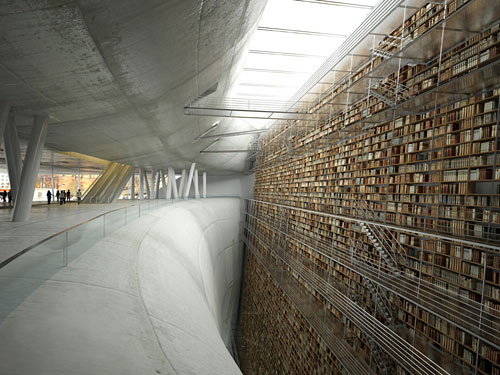
This is a library proposal for the recent architectural competition of the Stockholm library, i particular liked elements of this interior, such as the gang plank/scaffolding to access books. This design has been computer generated and i am hoping to achieve something of similar quality. the library will have a focus of just literature, with reading spaces provided.
15.3.10
Subscribe to:
Posts (Atom)